On this page 9 sections
Most people who have outsourced marketing to India have a story about it. Sometimes it's a good one. Often it's a vendor who said yes to everything, sent a different person to every call, and produced monthly reports full of activity with no change in leads. Six months later the work came back in-house and the conclusion was "offshore doesn't work".
We're a team in India, so we're not neutral on this. But having seen plenty of these arrangements from the other side, the problems are rarely about geography. They come from how the work was scoped, who was doing it, and what everyone agreed to measure. All three can be fixed before you sign anything.
Why companies outsource marketing to India
The obvious reason is cost. Experienced SEO specialists, ad managers and developers cost less in India than in London, New York, Sydney or Dubai, so the same budget buys more hands or more senior ones. For a small business that can't justify four marketing hires, that's the difference between doing one channel badly and doing three properly.
The less obvious reasons matter just as much. India has a deep pool of people who already work on international accounts every day, in English, inside the same tools you use: Google Ads, Meta, GA4, HubSpot, Shopify, WordPress. And depending on where you are, the time difference can work in your favour, which we'll come back to.
What usually goes wrong
When an offshore arrangement fails, it tends to fail in one of a few predictable ways.
- The scope was a list of tasks, not a result. "20 blog posts and 50 backlinks a month" gets delivered exactly as written, whether or not it moves anything.
- The team keeps changing. The senior person who pitched you hands the account to someone junior, who leaves in three months, and you explain your business all over again.
- Reports measure effort. Impressions, posts published and keywords tracked fill the slides, while leads and cost per lead are missing or vague.
- Accounts sit in the vendor's name. When you leave, the ad account history, the analytics and sometimes the website go with them.
- Shortcuts that look like progress. Cheap link packages, auto-generated content and copied pages can lift numbers briefly and then get a site penalised.
Notice that none of these is caused by distance. The same things go wrong with local agencies. Offshore arrangements just make them easier to miss, because you see less of the day-to-day work.
Decide what you're outsourcing first
Before talking to anyone, be clear about which of these you want:
- Execution only. You set the strategy, they do the work: building campaigns, writing pages, fixing technical SEO, designing ads. Works well if you have a capable marketer in-house who can brief and review.
- Strategy and execution. They plan and run a channel, or several, against a target you agree together. Works well if nobody in-house owns marketing full time.
- White-label delivery. You're an agency, and they deliver work under your brand to your clients. Works well if you have the client relationships but not the capacity.
Then start with one channel, not five. Pick the one with the clearest link to revenue, usually paid search or SEO, and expand once you trust how the team works. A small first engagement tells you far more than any proposal.
How to choose a partner
Proposals from offshore teams often look alike. These questions separate them quickly:
- Who exactly will work on my account, and will it be the same people in six months? Ask to meet them, not just the salesperson.
- Can I see a real report you send a client today? Names hidden is fine. You're checking whether it talks about leads and revenue or just activity.
- Whose name will the ad accounts, analytics, domain and code be in? The only acceptable answer is yours.
- What would you not do for us? A good partner will tell you which channels to skip or what to fix before spending more.
- How do you build links and write content? If the answer involves packages, volumes or tools that "generate" articles, walk away.
- Can we start with a small paid trial? Confident teams say yes.
Price matters, but be careful with the cheapest quote. Very low monthly fees for SEO or ads management usually mean either a very junior team or a lot of automation. You'll pay the difference later in cleanup.
Make the time difference work for you
Time zones are where people expect offshore work to hurt, and where it often helps instead. What matters is how much of your working day overlaps with India's, and planning around that rather than against it.
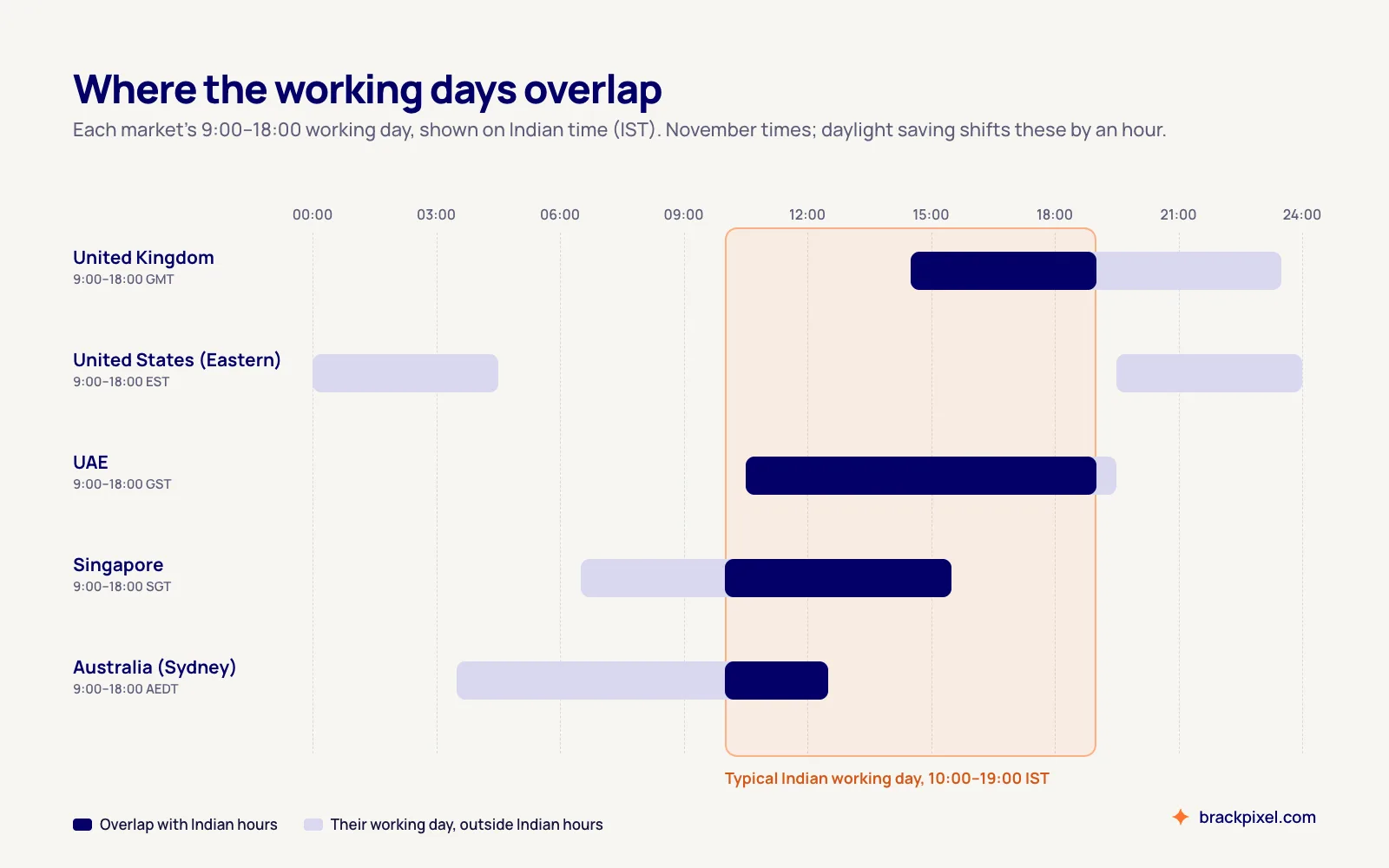
The UAE and the rest of the Gulf share almost the whole day with India, so it feels like working with a local team. Singapore overlaps most of its day. The UK gets the Indian afternoon, which covers the whole British morning. Australia overlaps its afternoon. The US East Coast barely overlaps at all, but that's what makes overnight turnaround possible: brief the team at the end of your day and the work is waiting when you start the next one.
Whatever your time zone, agree two things up front: a fixed weekly call at a time that suits you, and where everything else happens in writing, usually Slack, Teams or a shared project board. Most work doesn't need a meeting. It needs a clear brief and a quick reply.
Set it up properly
The first two weeks decide most of what follows. Before any work starts, put these in place:
- One target, in writing. Cost per lead, number of qualified leads, return on ad spend or organic enquiries, agreed with a realistic timeline per channel.
- Access in your accounts. Give the team user access to your Google Ads, Meta, analytics and website rather than letting them create new ones. Remove access the day the engagement ends.
- Tracking before spend. Forms, calls and WhatsApp clicks recorded properly, so everyone is judged on the same numbers.
- One owner on your side. Someone who answers questions and approves work within a day. Most offshore delays are really approval delays.
- A brand and approval process. Share your tone, examples you like and anything legally sensitive in your market, and approve ads and pages before they go live at least for the first month.
Protect your data and your brand
Sign an NDA and, if you handle customer data from the UK or EU, a data processing agreement. Your obligations under GDPR, or the privacy and anti-spam laws in your own country, don't disappear because the work happens elsewhere. Your partner should follow your rules on consent, cookies and email marketing, and should be able to explain how they do it.
Keep ownership simple: everything in your company's name, the partner works with user access, and you can remove that access in minutes. If you're an agency using a white-label partner, agree in writing that they won't contact your clients unless you ask them to.
What good looks like in the first 90 days
Month one is mostly audit, tracking and quick fixes: wasted ad spend cut, technical problems on the website resolved, campaigns restructured. You should see a clear written plan and a few early wins, not big results.
Month two is building: new campaigns, landing pages, content and the first proper tests. Paid channels should start showing a trend in cost per lead. Month three is where you judge. Paid search and social should be measurably better than where you started. SEO will still be early, but rankings and traffic for the pages that were worked on should be moving.
If by day 90 you're still mostly hearing about activity rather than results, have a direct conversation. A good partner will already have raised it.
Red flags
- Guaranteed rankings or guaranteed numbers of leads.
- Pricing based on volume, like posts or backlinks per month, with no mention of outcomes.
- Reluctance to give you admin access to your own accounts.
- A new contact person every few weeks.
- Reports you can't understand, or that never mention leads or revenue.
Outsourcing to India works well for a lot of businesses and agencies. The ones it works for treat it like hiring a team rather than buying a package: clear target, the right people, their own accounts, and a weekly habit of looking at the numbers together.
Thinking about an offshore marketing team? Tell us where you're based and what you need, and we'll show you how we'd work together.
See how we work