On this page 6 sections
If you run a business in India, you're probably already selling on WhatsApp whether you call it marketing or not. Customers message the number on your board or your Instagram bio, ask the price, and get a reply, sometimes a voice note, sometimes a photo of the product on the counter. A lot of sales happen exactly like that.
So the real question isn't whether to use WhatsApp. It's whether "WhatsApp marketing", sending messages out to lots of people at once, is worth it, and how to do it without annoying your customers or getting your number blocked. The short answer: it works very well for some jobs and badly for others.
Where WhatsApp genuinely earns its place
- Answering enquiries quickly. When someone taps a WhatsApp button on your website or an ad, they want a reply now, not tomorrow. A fast, friendly answer here does more for sales than any broadcast.
- Messages people actually want. Appointment reminders, order confirmations, delivery updates, a class that's been rescheduled. These get read because they're useful.
- Repeat orders. If people buy from you every few weeks, like groceries, snacks, coffee or pet food, a well-timed "running low?" message is helpful rather than pushy.
- Following up on a quiet lead, once. Someone asked for a quote and went silent. One polite message a few days later is reasonable. Five is not.
Where it backfires
The version of WhatsApp marketing that gives it a bad name is the blast: the same offer sent to thousands of numbers, many of which came from a bought list or were copied out of a group. People mute it, block it or report it. When enough people do that, Meta lowers your number's quality rating and can restrict what you're allowed to send.
The bulk-sending tools and modified WhatsApp apps that promise unlimited messages for a small fee are worse. They break WhatsApp's terms, and numbers used with them do get banned, sometimes along with years of customer chats. It isn't worth the risk to the number your customers already know.
There's a legal side too. India's data protection law expects you to have people's consent before you use their personal details for marketing. Messaging people who never agreed to hear from you is becoming a compliance problem as well as a reputation one.
The WhatsApp Business app, or the Business Platform?
The free WhatsApp Business app is enough for many small businesses. You get a business profile, a catalogue, quick replies and labels to sort chats. Broadcast lists only reach people who have saved your number, which is a sensible limit rather than a problem. Where it struggles is a team: several people answering from the same number gets messy fast.
The WhatsApp Business Platform, often called the API, is for when you've outgrown that. You use it through Meta directly or through a provider such as Interakt, AiSensy or WATI. It lets a whole team work from one number, connects chats to your CRM, sends automatic replies, and lets you send pre-approved template messages to people who've opted in. Meta approves templates before you can use them, and charges per message for marketing templates, so you think a little harder before sending each one. That's no bad thing.
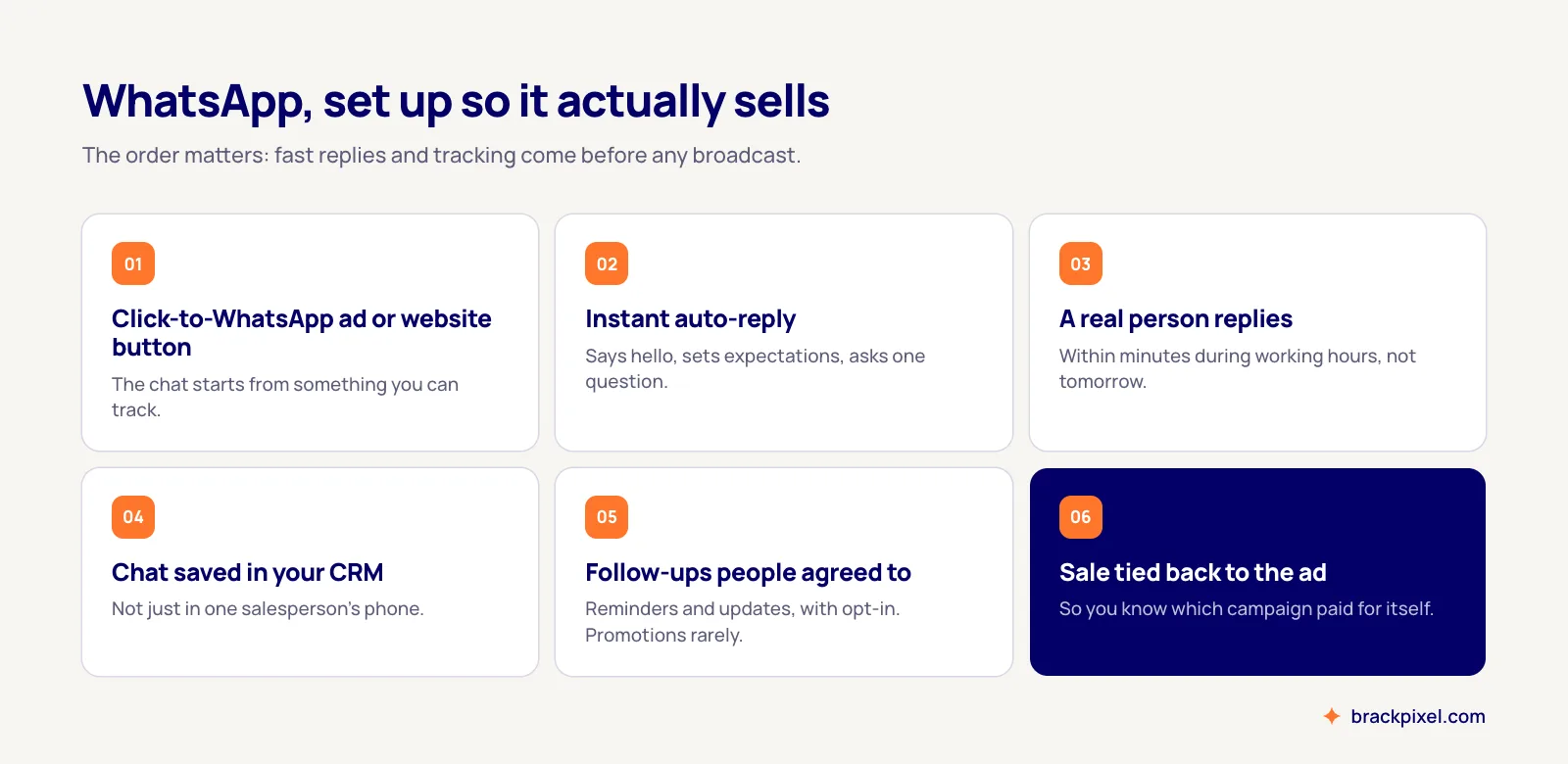
A setup that works
- Get consent properly. A tick box on your website form saying "Send me updates on WhatsApp", or the customer messaging you first, is your starting point. Keep a record of it.
- Reply in minutes, not hours. An automatic first reply that says hello and asks one useful question buys you a little time, but a real person still needs to follow up quickly.
- Keep every chat in one place. Leads that live only in one salesperson's phone disappear when that person is busy, on leave or leaves the company.
- Send promotions rarely. Useful messages can go whenever they're needed. Offers should be occasional enough that people still open them.
- Make it easy to stop. If someone replies "stop", stop. It keeps your quality rating healthy and it's simply good manners.
- Track where chats come from. Know which ad, page or post started each conversation, and which conversations became sales.
Click-to-WhatsApp ads deserve more attention
Most people think of WhatsApp marketing as messages you send out. Some of the best results come the other way round: Facebook and Instagram ads that open a WhatsApp chat instead of a form. For a lot of local businesses that's a better fit, because the customer can ask a question before committing, and a conversation feels more natural than filling in a form for a stranger.
The catch is staffing. Every chat these ads start needs someone to answer it, and a chat left unanswered for half a day is usually a lost customer. Before you spend on these ads, be honest about who's going to reply and how quickly.
Try this before you spend anything
For the next two weeks, keep a simple count: how many enquiries arrive on WhatsApp, how long each one waits for a reply, and how many turn into customers. If replies are taking hours, fix that first. It costs nothing, and it will almost certainly bring in more sales than a broadcast campaign would.
WhatsApp isn't a loudspeaker. It works best as a shop counter: somewhere customers come to ask questions and get a quick, helpful answer. Treat it like that and it can be one of the best-performing channels you have.
Want WhatsApp enquiries answered fast and tracked properly? We set up WhatsApp, CRM and automation that your team will actually use.
See how it works